





Events of SIEF Folk Arts and Vernacular Creativity Working Group
UPCOMING EVENTS
There are currently no upcoming events.
PAST EVENTS
“Folk Art in the Contemporary – Practices and Challenges”
23-24 April 2026 at Lund University (Sweden)
The Lund University and the SIEF Folk Art and Vernacular Creativity Working Group – with the generous support of the Gulli och Nils Strömboms Foundation – organized an international conference titled “Folk Art in the Contemporary – Practices and Challenges” at Lund University on 23-24 April. The event continued the scholarly events started in Split 2024 and was followed by a three-part panel at the SIEF 2025 Congress in Aberdeen. The participants reconsidered academic terminology on folk arts, folklorism, folkish arts, vernacular arts, popular arts, etc., drawing on inductive insights and case studies from ethnology, cultural anthropology, and museology. After these three fruitful events with excellent contributions and thought-provoking discussions, Lund University plans to publish a book with chapters based on the papers presented at the three conferences, edited by Jonas Frykman and Björn Magnusson Staaf, and hopes to have it ready by the next SIEF 2027 Congress in Bolzano. The conference participants covered a wide range of topics of folk and popular arts, vernacular creativity, and related fields. Here is a short description of the papers, following the order of the presentations:
Ágnes Fülemile (ELTE University, Research Center of Humanities, Institute of Ethnology) examined the process from the 19th century to the present, how folk life and folk art were perceived and imaged by painters, shaping the perceptions of not only the elite, but also evolving the demand for countless mediocre works and kitsch, penetrating an increasingly wild social strata with these images.
Fruzsina Cseh (ELTE University, Research Center of Humanities, Institute of Ethnology) outlined the complexity of the institutionalization of folk and applied folk arts in Hungary during the Socialist and Post-Socialist Era, including folkish, folksy, and folkloristic art forms, as well as various forms of folklorism. Consequently, the qualification system constructed the status of (applied) folk artist.
László Koppány Csáji (Research Institute of Art Theory and Methodology at the Hungarian Academy of Arts) explained the relation between historical reenactment, experimental archaeology, artistic reenactment, and the so-called (historical) tradition keepers in Hungary and their perceptions of folk art on the micro (individual) level, mezzo (groups) level, and their sociocultural context.
Jonas Frykman and Björn Magnusson Staaf (Lund University) outlined the origins, history, and proliferation of Swedish summerhouses, and how this expanding phenomenon affected the urban and rural lifeworlds in interaction with social changes. Moreover, in the last decades of the 20th century, the summerhouse became an emblematic image and representation of Swedish culture, inspiring contemporary art as well.
Nikolette Mackovicky (Oxford University) examined the relation between politics and contemporary forms of folk art in Slovakia. The endeavor to appropriate folk art by populist politics elicited several responses: using folk art as a tool and creatively rethinking folk techniques of social resistance. By blurring the borders between folk art and fine arts, these artistic expressions have become forms of social critique.
Mare Kõiva (Estonian Literary Museum) discussed the interrelation between cultural complexity and environment in Estonia. She compared many examples of how cultural changes occurred in everyday life: the dialectics of folklore patterns and innovations were constantly constructed and reconstructed in various forms, creating, for example, toys, dolls, and objects of contemporary spirituality.
Alfonsina Bellio (École Pratique des Hautes Études, EPHE-PSL, Paris) outlined the wide spectrum of folk, popular, and pop art as manifestations of reappropriation in the margins of Southern Italy: Calabrian revival of ephemeral ritual plant-statues (pupatze), Gerardo Sacco’s applied art based on antique and folk motives, and the folk-inspired works of Giuseppe Fata, Maria Simulacrum, Antonio Stallano, etc.
Anneli Palmsköld (University of Gothenburg) focused on the links between traditional textile and handicraft making and contemporary home-made crafting (such as hand knitting) in light of what to do with leftover yarn and rugs. The attitude of creating as an act of caring can be found in both folk art and contemporary handicraft in Sweden. DIY (do-it-yourself) and DIT (do-it-together) are also common denominators.
Rasa Pranskevičiūtė-Amoson (Vilnius University) focused on an international new religious movement (Anastasians) that originated in Russia in 1997, based on a novel series. They create love circles in the wilderness as an established, eclectic invented tradition, drawing on folk art elements and esoteric contemporary spirituality. This subcultural “imagined indigenousness” reenacts something “folkish” that never existed.
Ewa Klekot (University SWPS, Warsaw) outlined the persistence of the romantic myth of folk art. A new style was invented by the Polish artist Eleonora Plutyńska at the beginning of the 20th century in collaboration with a village weaver. Nevertheless, within three generations of local actors, the Podlasie-region style textile became a local brand, while the local tradition that Ms. Plutyńska rejected as a vernacular but tawdry style went out of fashion and ceased to exist.
After the 30-minute presentations, there were another 15 minutes to discuss them with questions and comments. Papers inspired a lively exchange of ideas and reflections on the presentations.László Koppány Csáji
(secretary of the working group)
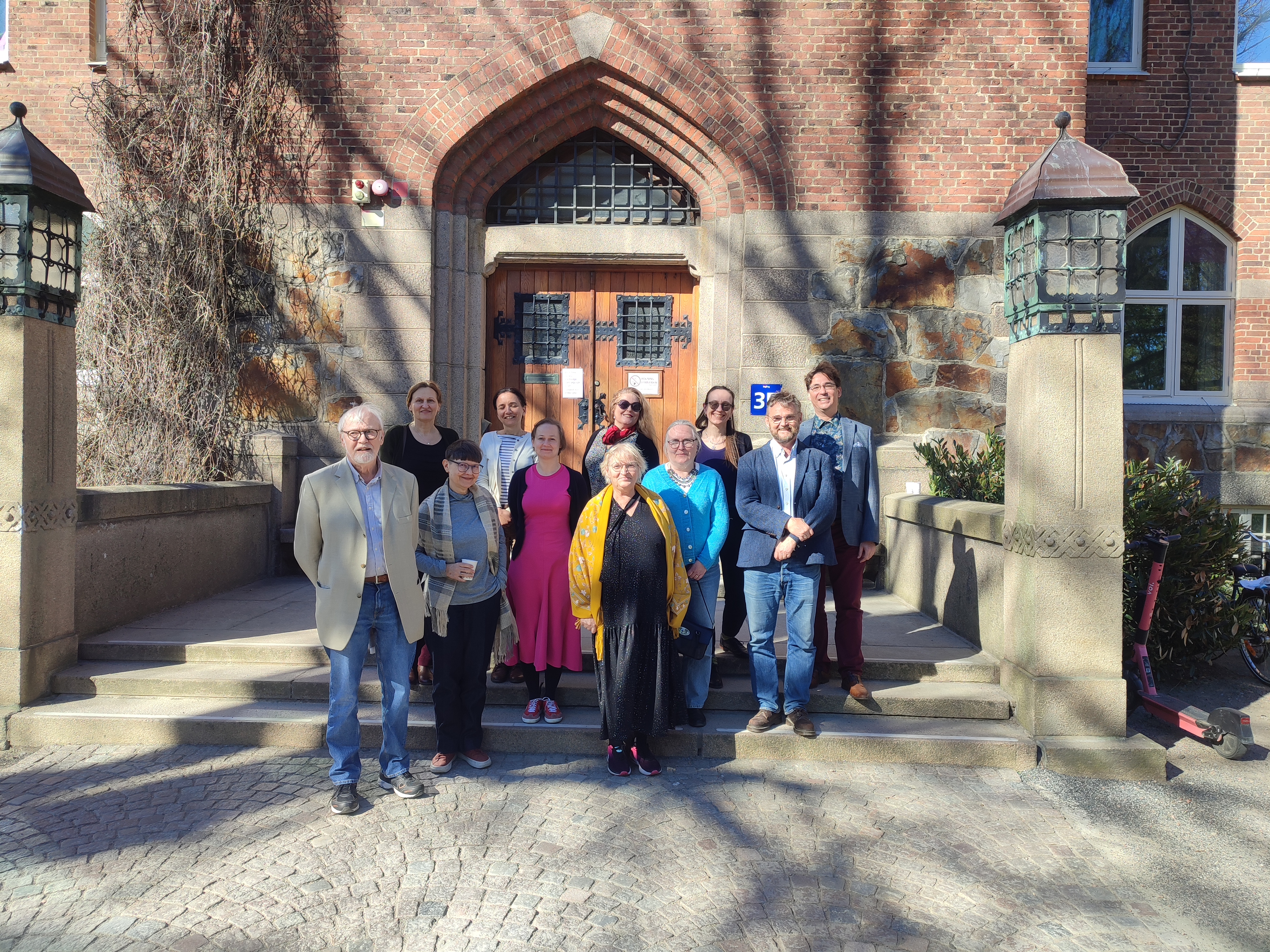
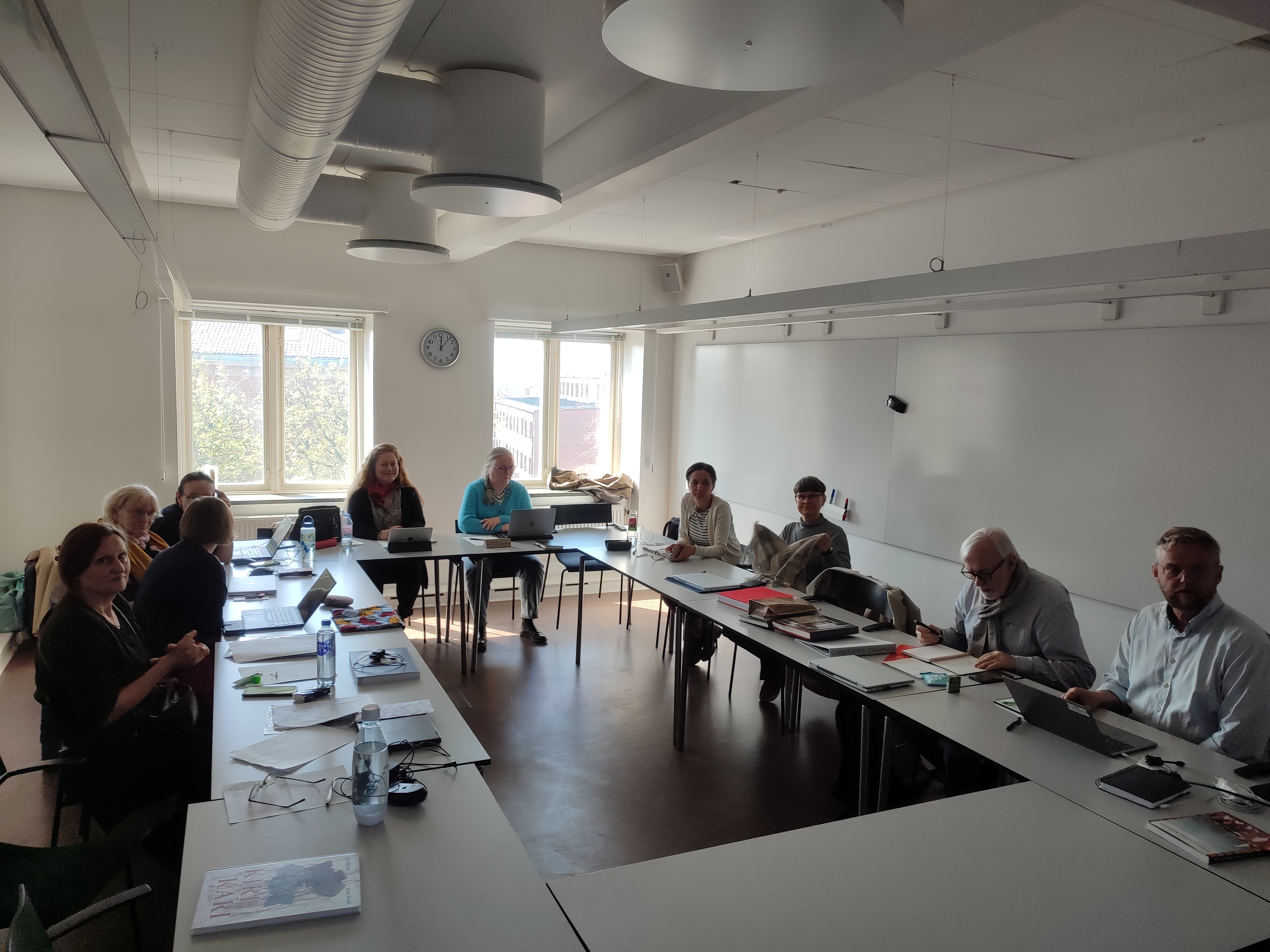
The participants in front of the Lund University Building